Global Sensitivity Analysis of TEMOA Using Optimal Transport Methods
The ongoing energy transition is reshaping energy systems worldwide through rapid renewable deployment, increasing electrification, and ambitious climate targets. At the same time, long-term energy planning is characterized by deep uncertainty, related to the techno-economic parameters used to represent available technologies (see Figure 1), resource availability, demand evolution, climate impacts, and geopolitical dynamics. Understanding how these uncertainties affect model-based insights is essential for designing robust and resilient energy transition pathways.
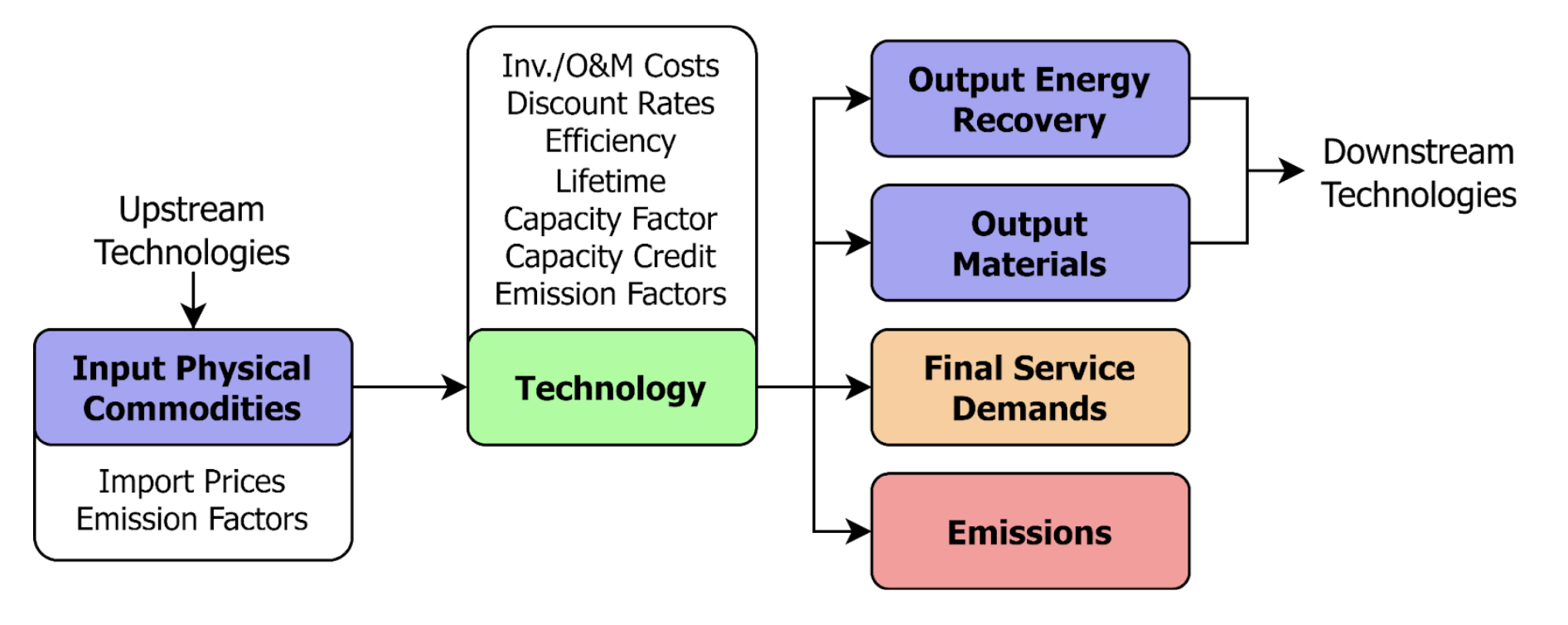
Figure 1. Illustration of the most important techno-economic parameters used to describe a technology in ESOMs and the connection with the different commodity categories: energy flows, material flows, final service demands and emissions.
Energy system optimization models (ESOMs) are widely used to explore cost-optimal energy transition scenarios in a detailed, technology-rich manner. However, their results inevitably depend on uncertain assumptions. Sensitivity analysis helps clarify which assumptions drive model outcomes and how uncertainty propagates through complex, multi-sector energy systems, improving transparency and supporting informed interpretation of scenario results.
From local to global sensitivity analysis
Traditional sensitivity analyses in ESOMs have often relied on one-factor-at-a-time (OAT) approaches, where a single parameter is varied while all others are kept fixed. While intuitive, these methods neglect interactions among inputs and fail to capture the multivariate nature of highly coupled energy systems.
To overcome these limitations, we focused on Global Sensitivity Analysis (GSA), which evaluates the influence of multiple uncertain inputs simultaneously on model outputs. GSA is particularly suited to modern ESOMs, where nonlinearities, cross-sectoral interactions, and structural constraints strongly shape long-term outcomes.
Optimal Transport–based GSA: a methodological advance
A key methodological contribution of this research line is the application of Optimal Transport (OT)–based sensitivity metrics to energy system optimization models. Optimal Transport, originally developed in mathematics and now widely used in statistics and machine learning, provides rigorous measures of distance between probability distributions.
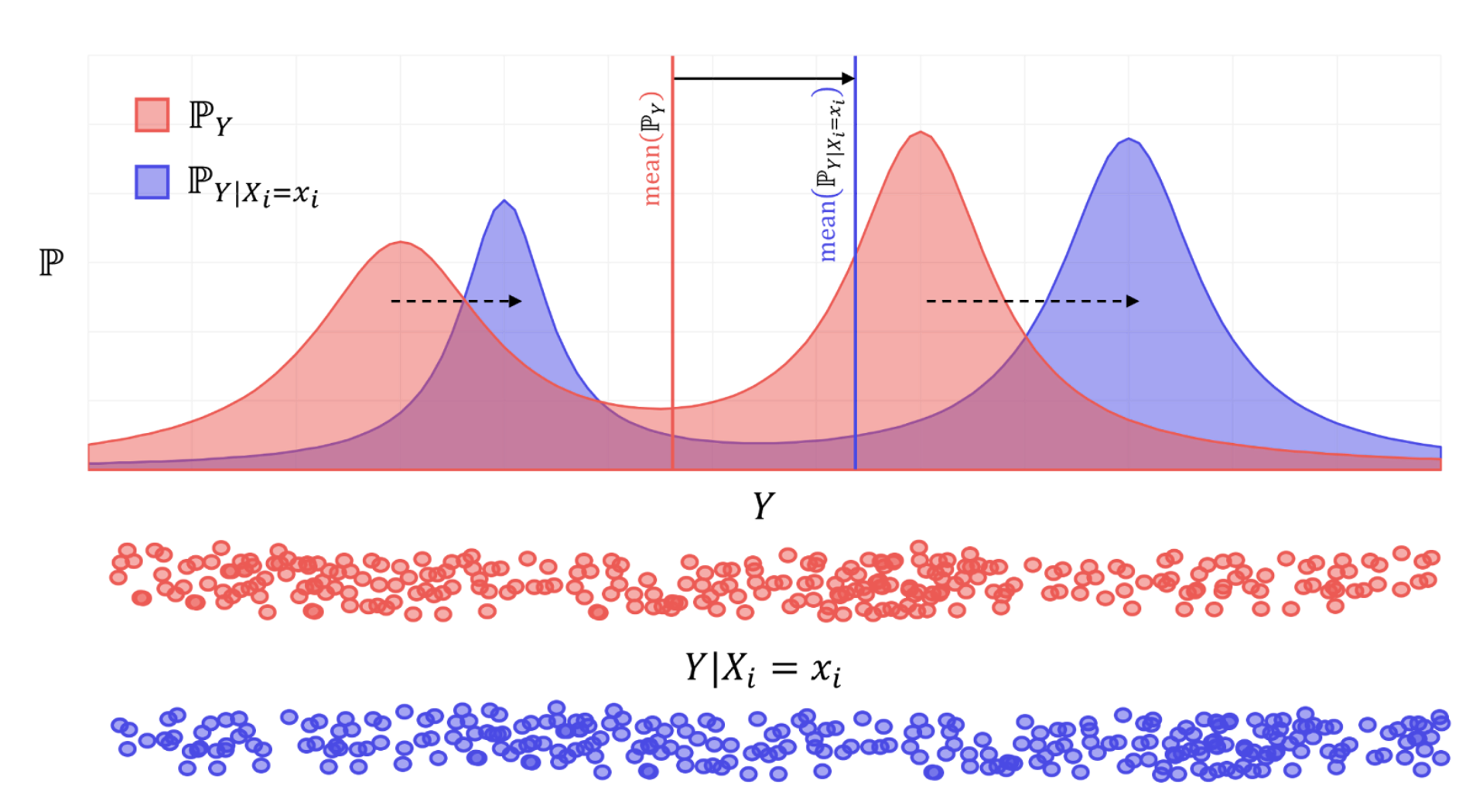
Figure 2. Schematic representation of the optimal transport methodology concept for evaluating the influence of a single input in determining the probability distribution of a single output.
In a GSA context, OT-based metrics quantify how much knowing the value of a specific input changes the distribution of model outputs, rather than focusing only on changes in variance or mean values (as represented in Figure 2). This makes the approach particularly well suited to:
- High-dimensional models with many outputs
- Technology-rich energy systems with quasi-nonlinear behavior
- Analyses aimed at identifying structural drivers of system change
This activity is carried out by the Matteo Nicoli (MAHTEP team) and Anderson Rodrigo de Queiroz (OEO team) in collaboration with Emanuele Borgonovo (Bocconi University) and Elmar Plischke (Clausthal University of Technology), combining expertise in energy system modeling, decision analysis, and sensitivity analysis theory.
Application to TEMOA and insights for energy transitions
The OT-based GSA framework has been applied to the full-scale, multi-sector TEMOA-Italy model, demonstrating that advanced global sensitivity analysis is feasible even for computationally demanding ESOMs. The approach relies on systematic sampling of uncertain input parameters, automated execution of large model ensembles, and structured post-processing at both system-wide and sectoral levels.
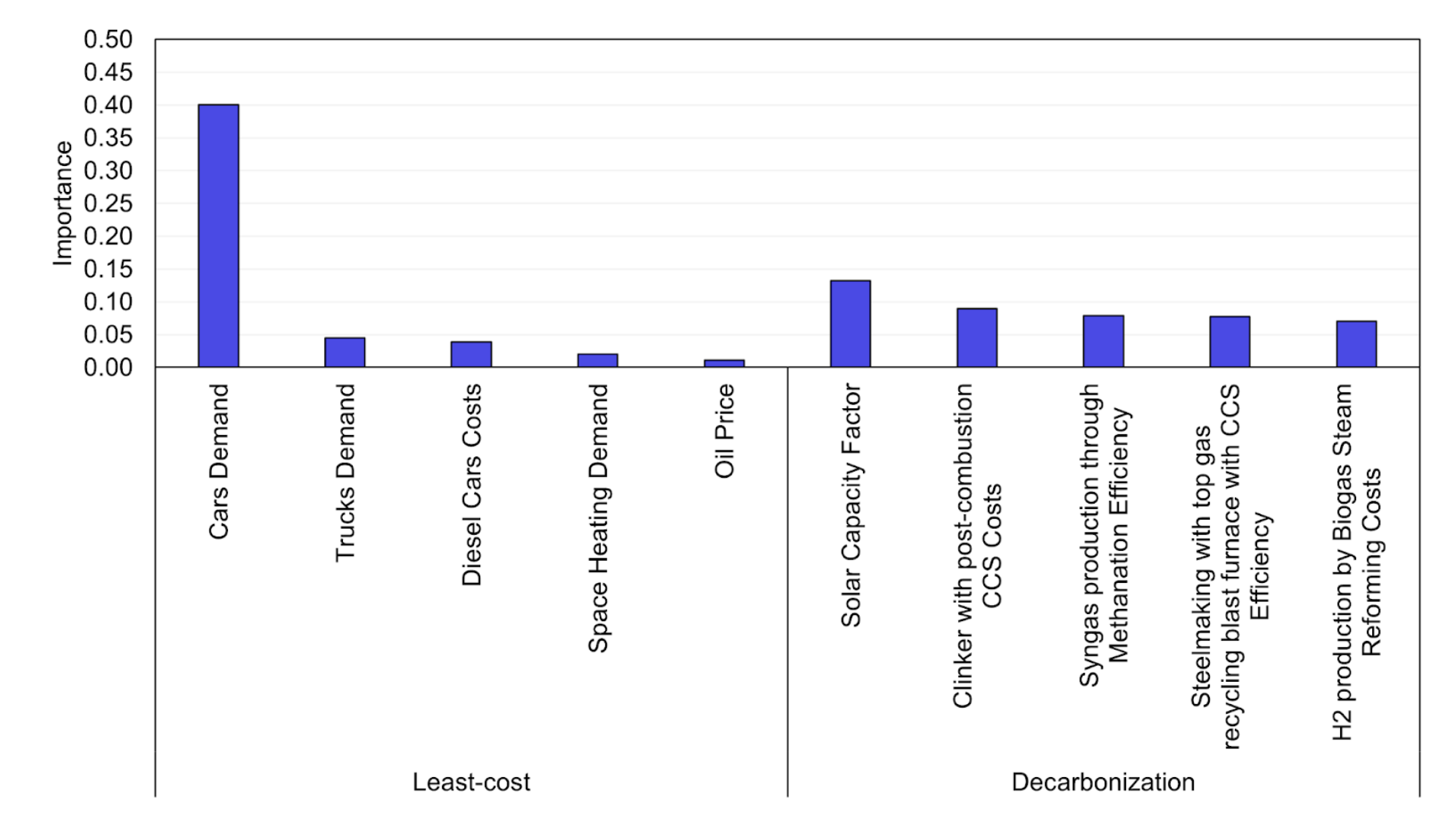
Figure 3. Ranking and importance values of the five most important inputs in determining the model objective function in a least-cost and in a decarbonization scenario.
The application to TEMOA provides several qualitative insights into long-term energy system behavior:
- Context dependence of uncertainty drivers: In a least-cost scenario (see Figure 3), uncertainties related to demand levels and economic parameters tend to dominate. Under stringent decarbonization or net-zero constraints, technical parameters and maximum potentials of low-carbon and flexibility technologies become the most influential drivers.
- Strong interaction effects: In a decarbonization pathway (see Figure 3), fixing a single influential input can significantly alter the importance ranking of other parameters, revealing non-additive and cross-sectoral interactions that remain hidden in local sensitivity analyses.
- Value of multi-output perspectives: Sensitivity results based on aggregated indicators (e.g., total system cost) can mask important sectoral dynamics. Some inputs may appear marginal at the system level while being critical for specific technologies or sectors.
A visual example of these effects is provided by the figure illustrating the transport sector results. The probability distributions of the most influential inputs and selected outputs show that scenarios with differentiated standard deviations assumed for the inputs (red in Figure 4) exhibit wider output ranges than uniform 10% assumptions (blue in Figure 4). This reflects the larger variability assumed for key drivers such as transport demand. This broader uncertainty also reveals additional clusters of outcomes - for instance in electricity consumption - indicating alternative technology configurations that are not explored under more homogeneous assumptions. Scatter plots and correlation coefficients further show that while some input–output relationships remain similar across the two configurations, others display distinct patterns, highlighting how assumptions on input uncertainty can significantly affect correlations, clustering of results, and the range of feasible transport sector outcomes.
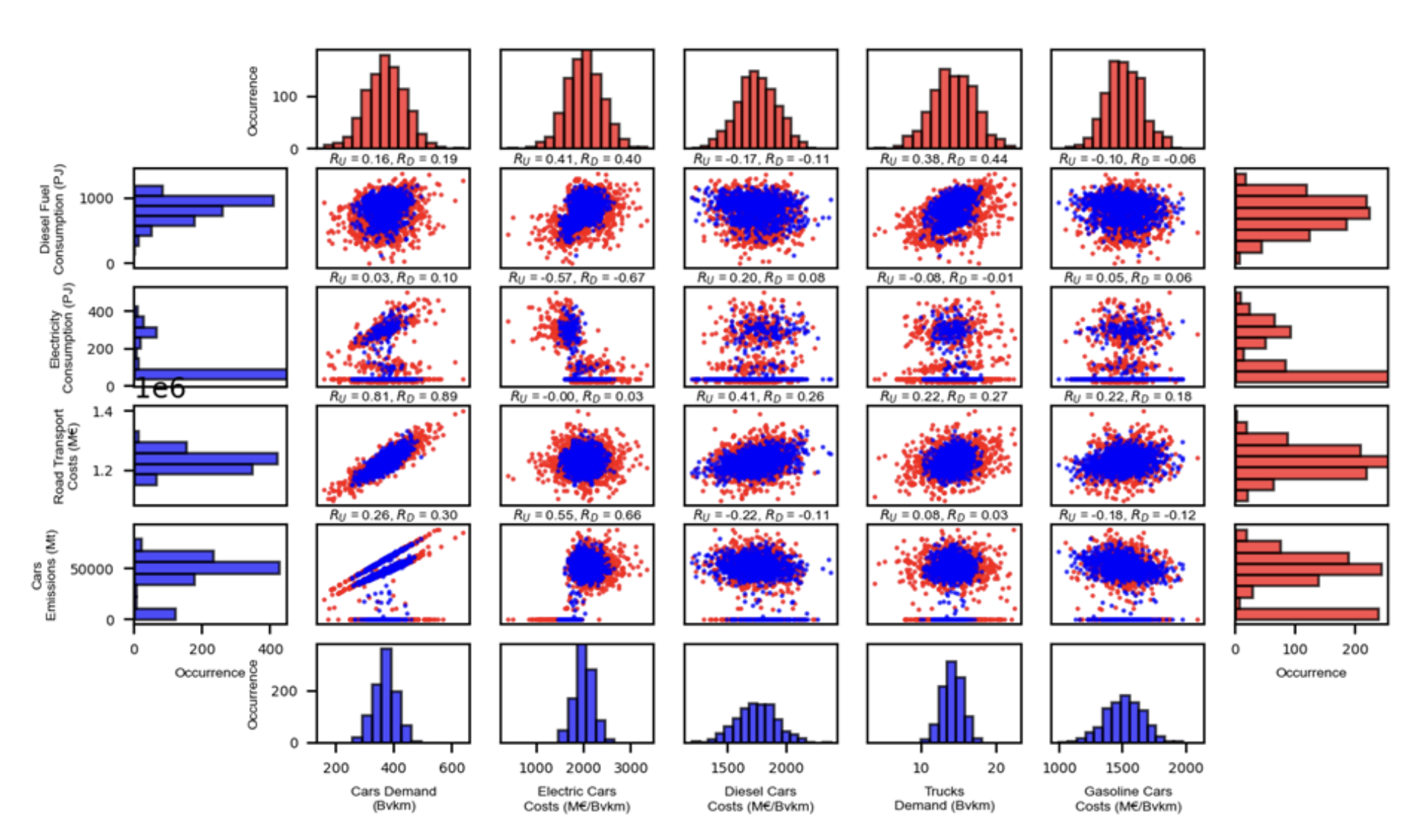
Figure 4. Probability distributions of the five most important inputs for the transport sector, probability distributions for a selection of transport sector outputs and scatter plots and correlation coefficients for couples of inputs and outputs.
Overall, the application of Optimal Transport–based Global Sensitivity Analysis to TEMOA shows how advanced sensitivity methods can complement scenario analysis and multi-objective optimization, helping uncover structural drivers, bottlenecks, and interaction effects in long-term energy transition pathways.
A paper on this topic has been published on Energy (Elsevier) in October 2025 and is available at https://doi.org/10.1016/j.energy.2025.138788.
About MAHTEP
The MAHTEP Group at Politecnico di Torino contributes to the development and application of the TEMOA energy system modeling framework through a long-standing collaboration with the Open Energy Outlook (OEO) team in the United States. Its work combines applied energy system modeling and methodological research, supporting energy planning across different spatial scales and policy contexts.
MAHTEP has been involved in the development of multiple TEMOA model instances, from continental and national to regional and local applications, and in the creation of automated preprocessing and postprocessing tools that enhance transparency, reproducibility, and large-scale scenario analysis.
On the methodological side, the group has contributed to multi-objective optimization within TEMOA and to the explicit representation of critical raw material requirements and supply risks across energy technologies. More broadly, its research addresses renewable fuel supply chains, key energy–environment nexuses, and the role of advanced nuclear technologies in long-term low-carbon transition pathways.